

In the previous year, sales representative Ryan Crumly forecasted that farmers would eagerly embrace drone technology once regulations permitted their use for applying insecticides and fungicides on crops.
He might have been correct.
At the end of June, Health Canada removed its limitations, allowing drones to spray approved pesticides. This shift has “opened the floodgates” for farmers interested in the technology, according to Crumly, who is employed by Titan Aero Drones.
“My phone has been busier than ever,” he remarked.
“We had nearly 80 drones available, and they sold out within days.”
Farmers and drone retailers are pleased with the regulatory change, claiming that these aerial devices can outperform traditional ground sprayers and aircraft. The adoption rate of pesticide-spraying drones is anticipated to be substantial, with numerous farmers expressing intentions to purchase one in the near future.
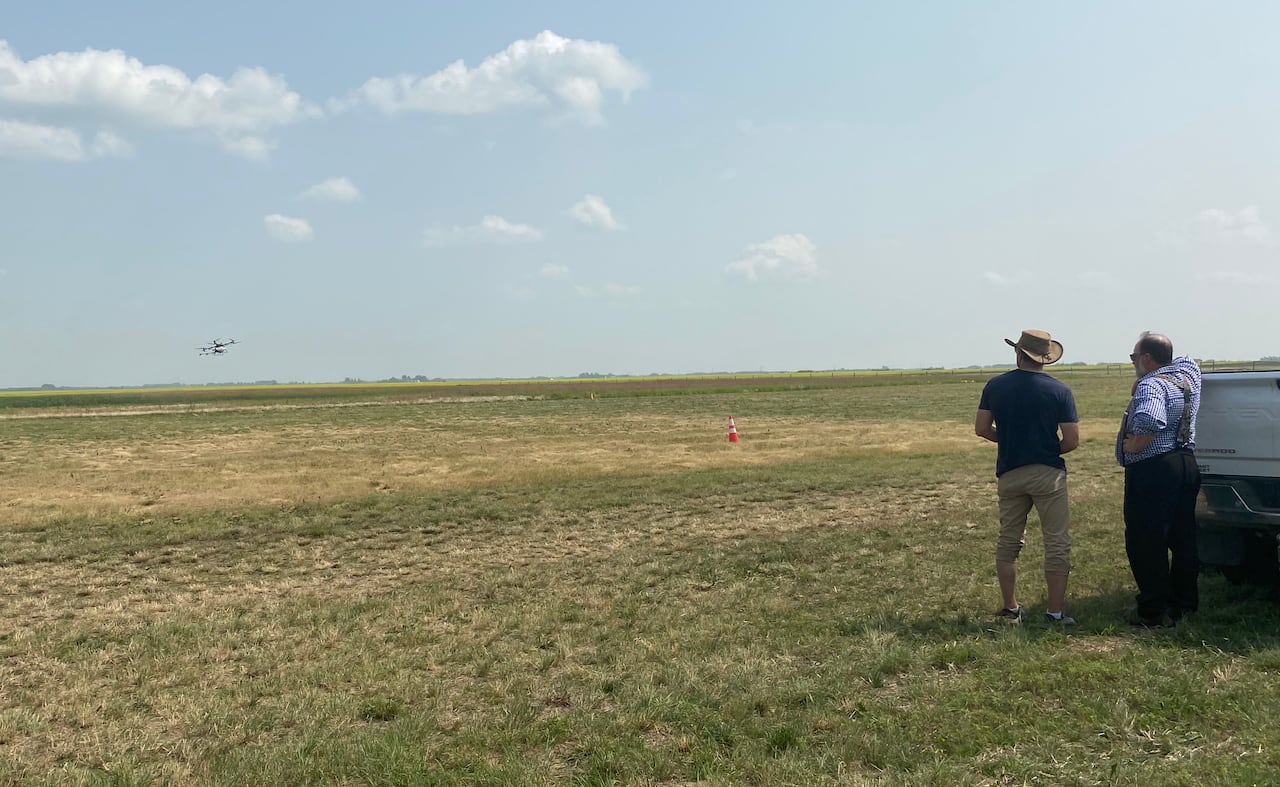
Two attendees of the Ag In Motion convention observe a demonstration of a spray drone on July 22, 2026 in Langham, Sask. (Maia Tustonic/CBC)
‘You’re just a babysitter’
Drones designed for pesticide spraying are being hailed as an innovative technology with numerous advantages.
For starters, they surpass planes and helicopters since the latter can only operate during daylight hours and struggle to navigate near trees or power lines, Crumly explained.
This year, he also received inquiries from farmers particularly interested in drones due to flooding conditions causing their ground sprayers to become mired in mud.

Artificial intelligence is being utilized across various industries, including agriculture. Many cutting-edge advancements will be showcased at Ag in Motion, Western Canada’s largest farm expo, located just 15 minutes northwest of Saskatoon in Langham. Professor Steve Shirtliffe spoke with Saskatoon Morning host Candice Lipski.
Crumly noted that drones are user-friendly. Farmers can outline the areas and methods for the drone to follow, allowing it to operate mostly on its own.
“You’re merely a supervisor who replaces batteries and refills the tank,” Crumly stated.
Greg Hill, who manages a farm and ranch in southeast Saskatchewan, expressed that he anticipates drones to have a “significant impact” on the agricultural sector.
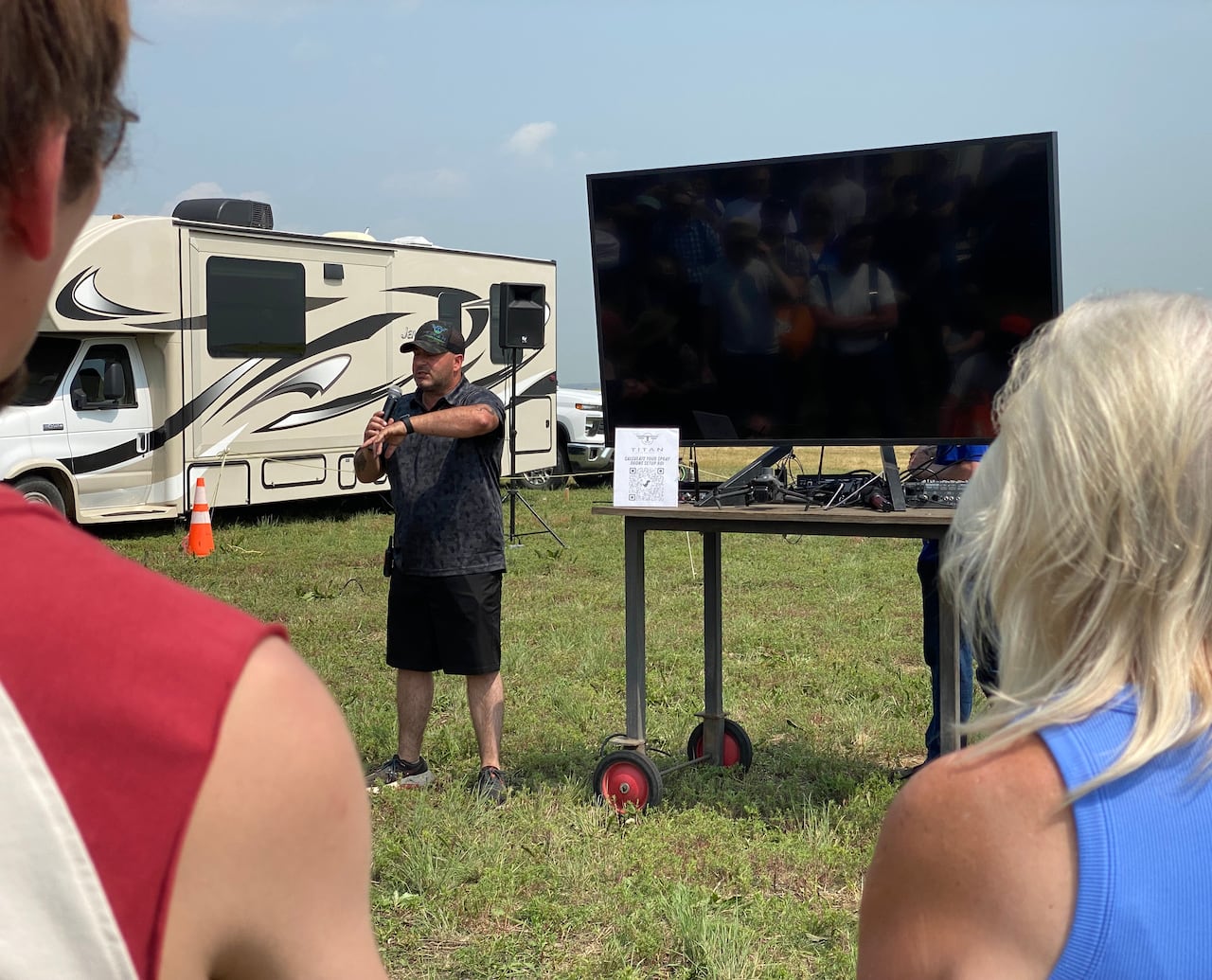
Ryan Crumly, a salesman for Titan Aero Drones, addresses attendees of the Ag In Motion convention regarding spray drones on July 22, 2026 in Langham, Sask. (Maia Tustonic/CBC)
Even with slim tires, ground sprayers can compact 22 to 24 acres of crops during operation, Hill noted, potentially leading to a loss of nearly $15,000 in canola yields. Drones, however, would not encounter that problem.
“The drone pays for itself quickly,” Hill remarked.
How rapidly will adoption occur?
The price of spray drones can reach tens of thousands of dollars. Yet, that is relatively inexpensive when compared to ground sprayers that can run into the hundreds of thousands, according to Crumly.
The operational expenses are also lower—approximately 83 cents per acre for drone use, in contrast to $10.50 per acre for a high-clearance ground sprayer.
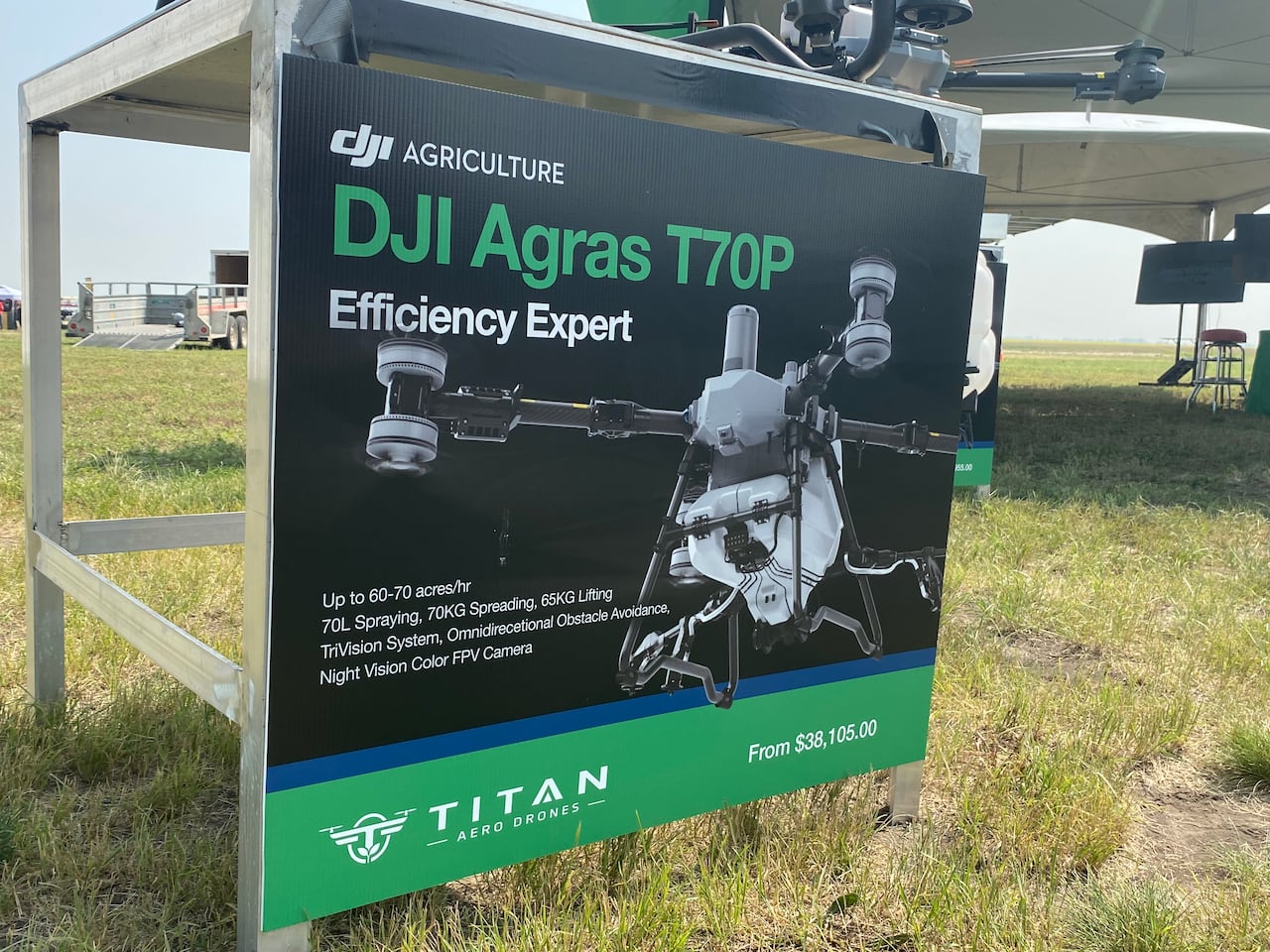
A poster displays a spray drone at the Ag In Motion convention in Langham, Sask. on July 22, 2026, indicating prices for the drone start above $38,000. (Maia Tustonic/CBC)
However, farmers are still cautious regarding the initial investment.
“My main concern is that my budget isn’t quite sufficient yet,” Hill admitted.
While he acknowledged that drones represent “the future,” Hill mentioned that the technology might not cover extensive acreage at once and likely requires further refinement. Nonetheless, he is actively contemplating acquiring one.
-
2 Sask. research farms slated to close will now stay open
-
Sask. farmers long for warmer days as crops suffer from severe weather
Raymond Phillips, who operates a farm in Alberta northwest of Lloydminster, is also monitoring advancements in this technology. He is cautious about the additional costs that may accompany owning a drone beyond its purchase price.
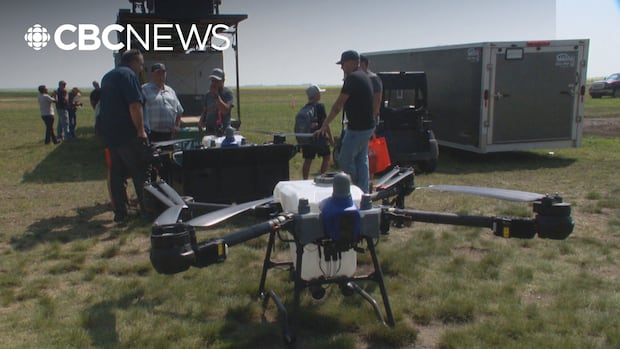
Health Canada lifted its restrictions to allow drones to spray pesticides at the end of June. Since then, dealers and farmers say there’s been a surge of interest in the technology.
“You require a mixing system, a generator, and a pilot’s license,” he pointed out. “There are numerous components to consider before deciding to make a purchase today.”
However, Phillips envisions himself acquiring one within the next two or three years.
“They are still in the developmental phase,” he remarked. “But I believe it is an inevitable advancement.”
