

Prime Minister Mark Carney unveiled a range of new initiatives aimed at assisting Canada’s steel and lumber industries, which have faced significant challenges due to U.S. tariffs. These measures include financial support and efforts to restrict the influx of foreign products into the Canadian market.
In a statement from Carney’s office, it was revealed that the federal government is addressing foreign steel imports from both nations that have free trade agreements with Canada and those that do not.
For nations lacking a free trade agreement, Canada will be reducing their tariff rate quotas for steel products from 50 percent to 20 percent of what was established for 2024.
A tariff-rate quota indicates a cap on the amount of a product that can be brought into the country at a reduced duty. Essentially, countries without a free trade agreement with Canada will be allowed to import less steel at more favorable tariff rates.
During a press briefing on Wednesday afternoon, Carney mentioned that this action could generate over $850 million in domestic demand for Canadian steel.
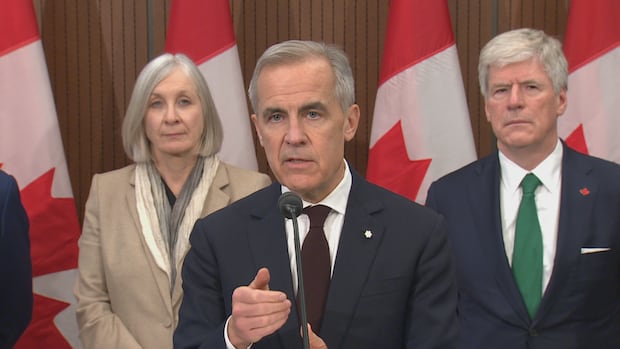
Prime Minister Mark Carney announced new measures to help the steel and lumber sectors, aiming to limit foreign imports in order to increase domestic production and use. Carney said the new measures will empower Canadian workers and businesses to adapt to the new global landscape.
For nations holding a free trade agreement with Canada, excluding the United States and Mexico, the federal government will be decreasing their quotas for steel products from 100 percent to 75 percent of the 2024 levels.
Before the announcement, a federal official provided a technical briefing for the press, explaining that adjusting quotas instead of imposing a direct tariff aids Canadian firms in shifting away from reliance on foreign steel while still allowing some imports.
Additionally, the federal government has decided to terminate the temporary exemption from Canadian tariffs on steel imported for manufacturing, food and beverage packaging, and agricultural production.
This temporary exemption is set to conclude on January 31, 2026, as stated in the press release.
Catherine Cobden, president and CEO of the Canadian Steel Producers Association, expressed in an interview on CBC’s Power & Politics that the new initiatives provide the steel sector “a fighting chance” in the ongoing trade conflict with the United States.
Cobden asserted that her organization “produces most of what Canada requires” and sees this as an opportunity to recover lost ground.
“We are in a significantly better situation today compared to yesterday,” she noted.
Lumber supports, freight rate subsidy
For several months, provinces such as British Columbia and New Brunswick have urged Ottawa to enhance support for their softwood lumber industries, currently facing a 45 percent tariff imposed by U.S. President Donald Trump.
In response, Canada will allocate $500 million in funding through the large enterprise tariff loan facility to assist lumber companies experiencing financial difficulties, as mentioned in the press release.
The federal government is also contributing an additional $500 million to the Business Development Bank of Canada’s softwood lumber guarantee program and is creating a unified application process for companies seeking support.

B.C. Premier David Eby says Canadian lumber now faces higher tariffs going into the U.S. than lumber from Russia, and the higher tariffs going into effect must be treated by Ottawa like a national emergency.
In August, the federal government announced a $1.2 billion support package for the softwood lumber sector. CBC News has contacted various governmental departments to confirm if these supports have been implemented.
According to the press release, the federal government is also advocating for rail companies to reduce freight charges for transporting Canadian steel and lumber across provinces by 50 percent, starting in the spring.
Carney indicated that this reduction will be funded through Canadian National Railway and Canadian Pacific Kansas City. A government representative during the technical briefing estimated the annual cost to be around $146 million.
Derek Nighbor, president and CEO of the Forest Products Association of Canada, described the announcement as a positive development, expressing confidence that the federal government recognizes the urgency of the situation.
“The essential task now is to design and structure programs that expedite the release of funds,” Nighbor stated. “The additional financial support is appreciated, but the focus must be on execution, and that is what we will hold the government accountable for.”
Tariffs and turmoil
This year, Canada’s steel and aluminum producers have found themselves in the midst of escalating trade disputes between Washington and Ottawa.
In March, Trump imposed a 25 percent tariff on Canadian steel and aluminum, and in June, he increased these tariffs to 50 percent.

U.S. President Donald Trump says that all trade talks with Canada are terminated in a post on his Truth Social platform. He cited a complaint by the Ronald Reagan Presidential Foundation & Institute about a ‘selective’ clip of Reagan talking about tariffs in an ad by the Government of Ontario.
Recently, Trump abruptly terminated all trade discussions with Canada, expressing dissatisfaction with an advertisement from the Ontario government that utilized President Ronald Reagan’s words in an anti-tariff message aimed at an American audience.
Trump stated that Carney later apologized regarding the advertisement.
Despite this, discussions with the U.S. have yet to be “revived,” Carney informed reporters earlier this month.
