

Experts on the militant organization suggest that the two individuals accused of executing the deadly mass shooting at Sydney’s Bondi Beach may have been motivated by ISIS or may have undergone actual training to facilitate the assault.
“Initially, I suspected this could be inspired by ISIS. Now, I believe it might have been either ISIS-enabled or ISIS-directed,” stated counterterrorism specialist Colin Clarke regarding the incident that resulted in 15 fatalities during a Hanukkah event.
Authorities have identified the suspects as a father and son duo, aged 50 and 24. The older individual, named Sajid Akram by state officials, was killed by police. His son, Naveed Akram, suffered injuries and remains hospitalized, having regained consciousness from a coma on Wednesday.
The pair reportedly opened fire on a crowd of hundreds for approximately 10 minutes at the well-known tourist location, causing panic and prompting people to seek refuge.
Both traveled to the Philippines
According to police, a vehicle located at the scene, registered to the younger suspect, was found to contain homemade explosive devices and two ISIS-associated flags.
Australia’s federal police commissioner, Krissy Barrett, later remarked that the shooting was “a terrorist attack motivated by Islamic State.”
In addition, the suspects’ recent visit to the southern Philippines, an area known for housing ISIS-linked groups, has intensified speculation concerning their connections to the militant organization.
Clarke, who leads the Soufan Center, a security think tank based in New York, noted that the shooting technique displayed by one of the assailants, as captured in footage of the incident, indicates he had received training.
“This person was not inexperienced,” he stated.
However, police confirmed that the deceased suspect, Sajid Akram, was a licensed firearm owner and was affiliated with a shooting club.
Clarke asserts that the presence of ISIS flags and the recovery of IEDs are “characteristic features of a typical ISIS attack.”
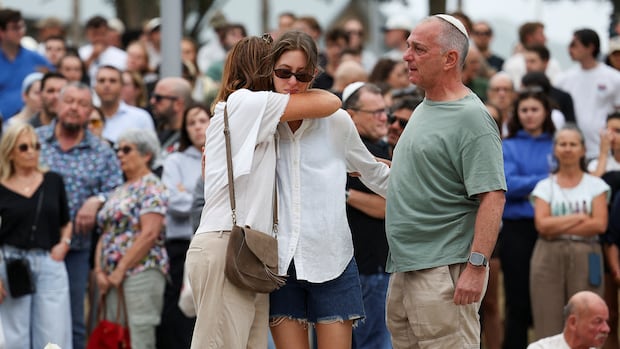
Australia’s prime minister stated that the mass shooting at a Hanukkah celebration in Bondi Beach seems to be driven by ISIS ideology. Meanwhile, mourners flocked to the site to pay their respects and honor the victims, including a 10-year-old child.
Bruce Hoffman, a senior fellow specializing in counterterrorism and homeland security at the Council on Foreign Relations, expressed that the random attacks previously executed by ISIS make it “100 percent plausible” that the group had a role in this incident.
“The discovery of the flags in their vehicle makes it almost irrelevant. It is evident that they framed their violence within an ISIS context.”
“The critical inquiry is, what was their relationship with ISIS?” he questioned. “Was it a direct command-and-control operation?” — implying whether the attackers were acting under explicit orders from the organization.
Nonetheless, he emphasizes the larger concern regarding how and when they became radicalized.
Philippine immigration authorities report that both individuals arrived in Manila and then traveled to Davao in the southern region of the country on November 1, returning on November 28, just weeks prior to the Bondi shooting. However, they noted that this does not definitively link them to any terrorist organization or suggest they received training in the country.
Muslim separatist militant factions, such as Abu Sayyaf in the southern Philippines, have previously expressed support for ISIS and hosted a limited number of foreign militant fighters from regions including Asia, the Middle East, and Europe.
Nonetheless, decades of military operations have significantly weakened groups like Abu Sayyaf, and officials from the Philippine military and police have indicated there have been no recent signs of foreign militants in the southern part of the country.
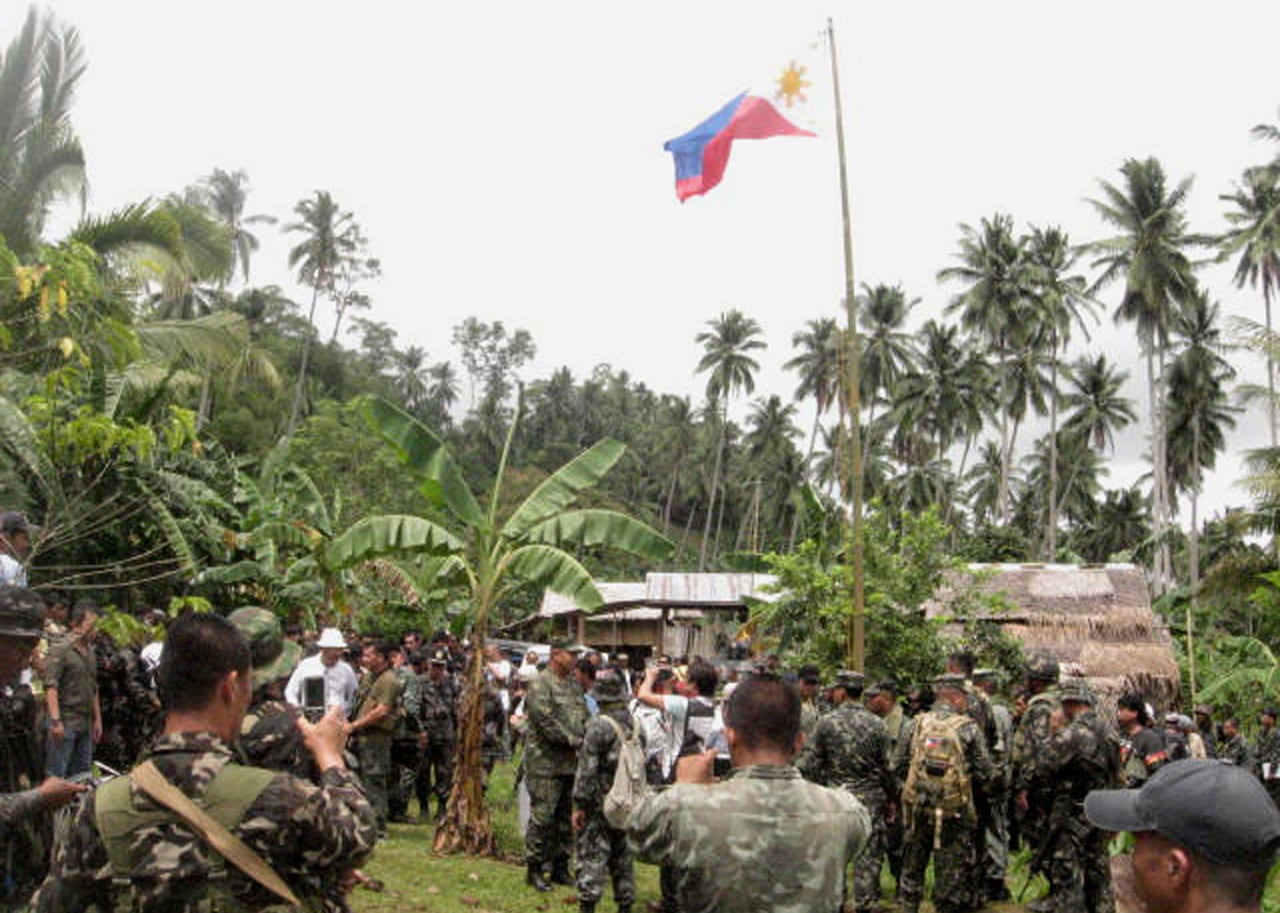
Soldiers raise a Philippine flag at a camp seized from Abu Sayyaf militants on Jolo island in the southern Philippines on September 21, 2009. Experts indicate that ISIS-affiliated groups in Southeast Asia have been considerably weakened but still represent a threat. (Western Mindanao Command/Reuters)
Both Hoffman and Clarke concur that ISIS-related factions in Southeast Asia have experienced significant degradation over recent years.
Nevertheless, Clarke asserts that remnants still possess sufficient strength to provide individuals and small groups with the necessary training and logistical aid to execute deadly terrorist operations.
“This appears to be the situation at hand,” he remarked. “The Filipinos have effectively countered many of these threats, but the issue has not been entirely eliminated.”

An Islamic State flag lies on the ground rolled up behind the pickup truck that Shamsud-Din Jabbar drove into a crowd on Bourbon Street in New Orleans on January 1. That attack was reported to be influenced by ISIS. (Gerald Herbert/The Associated Press)
‘Fingerprints could be all over this’
Clarke suggested that ISIS may have provided assistance with both training and target selection.
“They might have been involved in choosing the Hanukkah event on the beach. They could have encouraged the suspects to build IEDs. They may have instructed them to incorporate homemade ISIS flags. The details remain unclear.”
“Their influence could be evident throughout this incident.”
Clarke, who monitors and analyzes ISIS activities, indicates that these potential associations serve as a reminder that, despite being weakened, ISIS still represents a threat.
-
THE LATEST
What we know so far about the Bondi Beach attack
-
Video
Shooting victims remembered at Bondi Beach memorial
-
What we know about Ahmed al-Ahmed, the Bondi Beach bystander who disarmed gunman
“This threat remains highly relevant,” he mentioned. “They have reverted to traditional terrorism, utilizing classic guerrilla tactics. They still possess the capability to enter public spaces in the West and harm civilians, whether by inspiring others to commit acts in their name or through training and deploying individuals directly.”
In recent years, groups associated with ISIS have conducted a series of deadly assaults. Hoffman notes that ISIS tends to target “unexpected locations,” such as Sri Lanka on Easter Sunday in 2019, attacks in Iran, Istanbul, and Moscow in 2024, and the New Orleans incident in January 2025.
He emphasizes that ISIS continues its operations, despite being weakened by the defeat of its governing structures in Iraq and Syria and the dismantling of its caliphate in 2019.
“They may be diminished, but they are not eradicated, and their interest in executing attacks remains.”
