

On Tuesday, U.S. President Donald Trump announced that he is implementing a blockade of all “sanctioned oil tankers” headed to Venezuela, intensifying the pressure on the nation’s authoritarian leader, Nicolás Maduro. This action appears aimed at tightening the economic stranglehold on the South American nation.
This escalation follows a recent incident in which U.S. forces seized an oil tanker off the Venezuelan coast, an uncommon operation that coincided with an increase in military presence in the area. In a social media post on Tuesday night, Trump claimed that Venezuela is using oil revenues to support drug trafficking and other illegal activities, and he pledged to further enhance the military buildup.
“Venezuela is entirely encircled by the largest naval fleet ever gathered in South America,” Trump stated on his social media platform. “It will only expand, and the shock they experience will be unprecedented — until they return to the United States all the Oil, Land, and other Assets they previously appropriated from us.”
He further declared that he is labeling the Venezuelan government as “a FOREIGN TERRORIST ORGANIZATION.”
In response, the Venezuelan government dismissed Trump’s “grotesque threat.”
Democratic Representative Joaquin Castro characterized the blockade as “unquestionably an act of war.”
“A war that Congress has not authorized and that the American public does not desire,” Castro added on X.
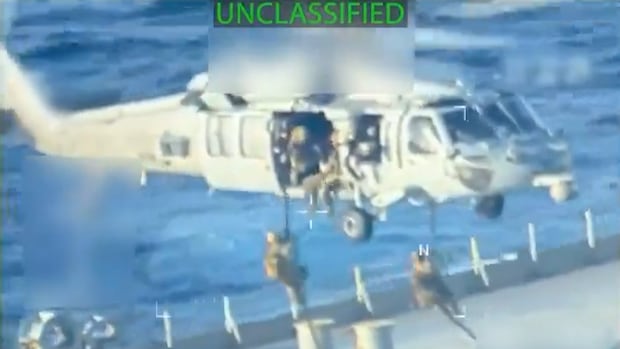
The U.S. has seized an oil tanker off the coast of Venezuela, President Donald Trump said on Wednesday, ratcheting up tensions with Caracas.
Pentagon representatives directed all inquiries regarding the post to the White House.
The military buildup has been accompanied by multiple attacks on vessels in international waters within the Caribbean and eastern Pacific.
This initiative, which has garnered bipartisan criticism among U.S. lawmakers, has resulted in at least 95 fatalities across 25 confirmed strikes on ships.
-
Trump confirms U.S. seizure of oil vessel off Venezuela, says ‘other things are happening’
-
Trump’s words on Venezuela spur 4 U.S. senators to file war powers resolution
-
Analysis
The U.S. has put military pressure on Venezuela for months. What’s the endgame?
The Trump administration has asserted that the operation aims to combat drug shipments destined for the U.S., but in a Vanity Fair interview released Tuesday, Trump’s chief of staff Susie Wiles appeared to confirm that the initiative is also intended to remove Maduro from power. Wiles stated that Trump “wants to continue destroying boats until Maduro concedes.”
The administration has defended this campaign as successful, claiming that it has hindered drug flow into the United States, while countering concerns that it may be overstepping the legal limits of warfare.
Most Venezuelan oil goes to China
Venezuela, home to the world’s largest proven oil reserves, produces approximately one million barrels of oil daily and has long depended on oil earnings as a crucial component of its economy.
Since the imposition of oil sanctions by the Trump administration in 2017, Maduro’s regime has relied on a covert fleet of unregistered tankers to funnel crude oil into global markets.
The state-owned oil enterprise, Petróleos de Venezuela S.A., commonly referred to as PDVSA, has been excluded from international oil markets due to U.S. sanctions. It primarily sells its exports at considerably reduced prices on the black market in China.
According to Francisco Monaldi, a Venezuelan oil specialist at Rice University in Houston, around 850,000 barrels of the one million produced daily are exported. Of that amount, he noted, roughly 80 percent is sent to China, 15 to 17 percent reaches the U.S. through Chevron Corp., and the remaining is directed to Cuba.
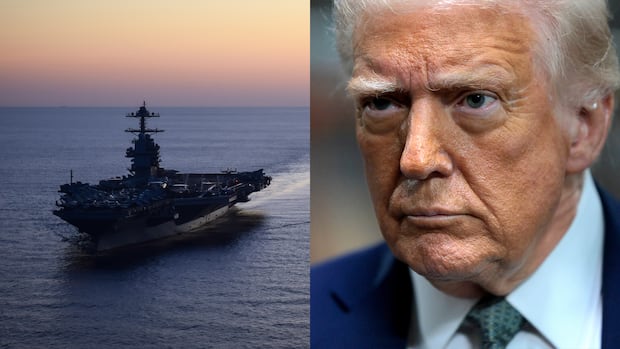
After a series of attacks on alleged ‘narco traffickers’ off Venezuela, the U.S. has deployed its largest aircraft carrier to the region. For The National, CBC’s Eli Glasner explains why President Trump’s show of force may go far beyond fighting drugs.
The specifics of how the U.S. intends to implement what Trump referred to as a “TOTAL AND COMPLETE BLOCKADE OF ALL SANCTIONED OIL TANKERS entering and exiting Venezuela” remain unclear.
However, it is known that the U.S. Navy has 11 vessels in the area, including an aircraft carrier and various amphibious assault ships.
These ships are equipped with a diverse array of aircraft, such as helicopters and V-22 Ospreys. Additionally, the Navy has been operating several P-8 Poseidon maritime reconnaissance aircraft in the vicinity.
Collectively, these resources provide the military with substantial capacity to monitor maritime movements in and out of the country.
