

The fossilized remains of a dinosaur skull discovered at a campground in British Columbia are identified as belonging to a tyrannosaur that was both lighter and quicker than its well-known relative, the T. rex, according to a recent study.
Researchers from the University of Alberta examined a cast of a partial skull impression that dated back approximately 76 million years, confirming it was from a horned dinosaur named Gorgosaurus.
The research, published in the journal Palaeogeography, Palaeoclimatology, Palaeoecology last month, sheds new light on a species that once inhabited what is now Western Canada, stated lead author Colton Coppock.
“We could identify [Gorgosaurus] thanks to a distinct set of features present on this impression,” Coppock noted.
According to the Royal Tyrrell Museum in Alberta, this species could grow up to nine meters in length.
Discovery near the riverbank
The quest to identify the dinosaur began in 2017 when Rick Lambert, a resident of B.C., stumbled upon an unusual rock while hiking at a campground in Tumbler Ridge, close to the Alberta border.
Lambert mentioned that his childhood experiences fossil-hunting in England had sharpened his observational skills—though he also credited a squirrel for drawing his attention to the rock by the riverbank.
The Tumbler Ridge Museum Foundation dispatched one of its paleontologists to investigate the find, leading to the revelation that Lambert had discovered the first tyrannosaurus skull ever recorded in British Columbia.
“While we have a lot of dinosaur material here, we don’t have much in the way of bones,” remarked Eamon Drysdale, the museum’s curator, adding that the original impression is securely stored in a sandstone block under strict environmental conditions.
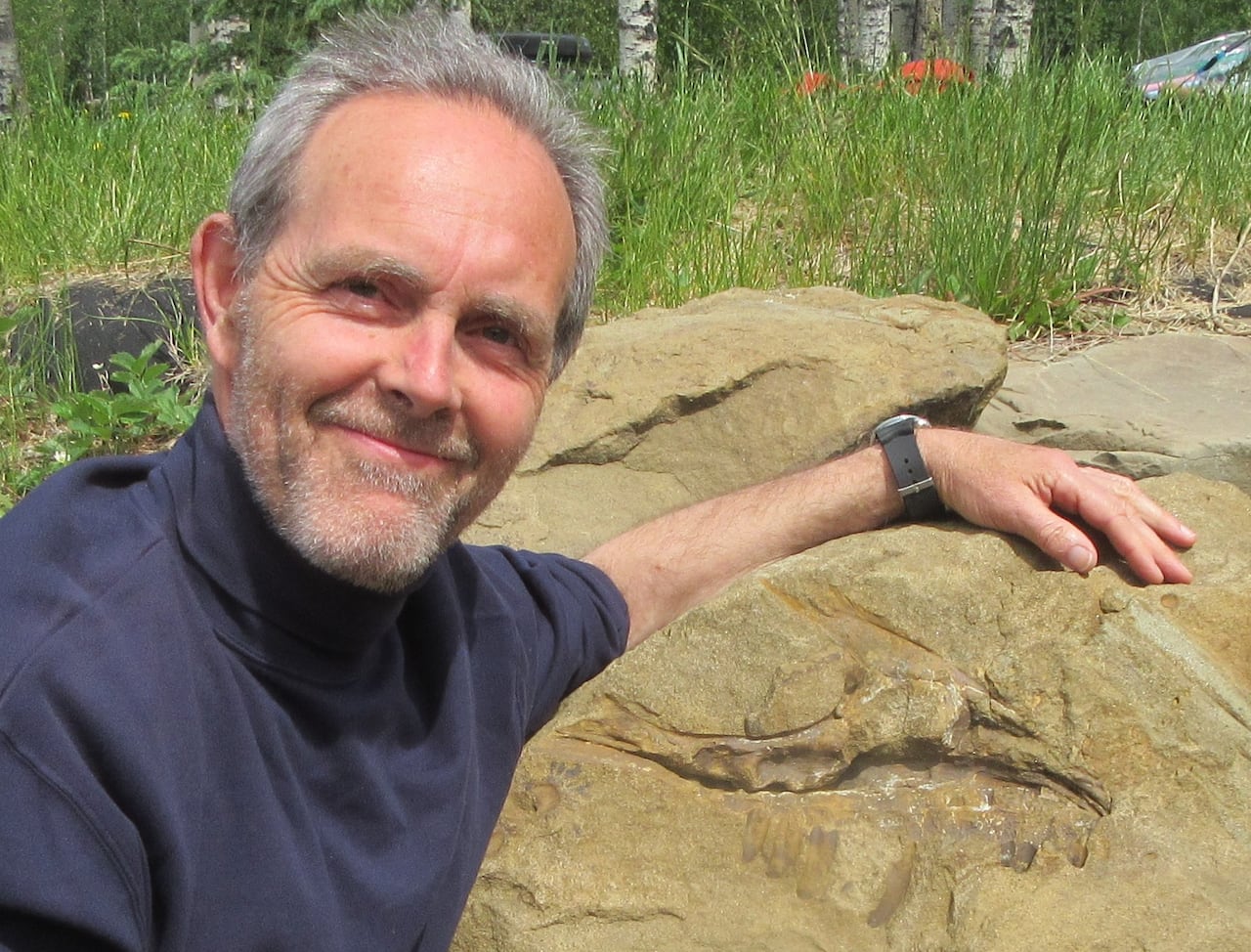
Rick Lambert stands next to his discovery. (Charles Helm)
A well-preserved imprint
The imprint included parts of the skull, such as the dinosaur’s maxilla, or upper jaw.
Despite most of the actual bone having deteriorated, the impression was sufficiently preserved for researchers to create a highly detailed cast that captured the skull’s distinctive traits.
Coppock recounted how his supervisor casually placed the cast on his lap during a barbecue last August, and he instantly recognized it likely belonged to Gorgosaurus libratus.
This species existed 76 million years ago, around 10 million years prior to the era when T. rex roamed the Earth.
“It’s likely akin to T. rex’s great-uncle,” Coppock remarked.
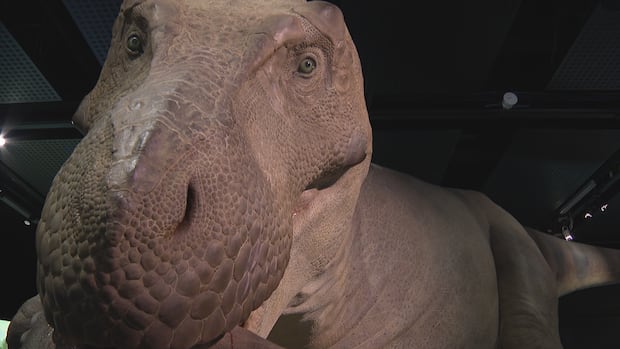
While both dinosaurs had similar short arms and extended tails, Gorgosaurus was distinguished by the triangular horns above its eyes, Coppock explained.
“They are generally more lightly constructed tyrannosaurs with longer limbs. Think of them as a faster version of T. rex,” he added.
The cast enabled Coppock and his collaborators to examine the internal surface of the maxilla and compare it with more complete skull bones of Gorgosaurus.
Gorgosaurus is among the most extensively documented tyrannosaurs in Alberta and was one of the earliest dinosaurs discovered in the province’s Dinosaur Park Formation, providing researchers with ample material to study.
Some indicators linking the partial skull to Gorgosaurus included the bone sutures located in the nasal region and a bony rod that separated openings in its upper jaw, which were characteristic of the dinosaur, Coppock mentioned.
He noted that the teeth of the dinosaur indicated it was likely a juvenile at the time of its death.
“These animals do not possess large, powerful jaws when they are young, so we think they were using these incisor-like teeth to accurately cut flesh, rather than relying on sheer force and taking large bites with their blade-like teeth, as adults do,” he explained.
A new avenue for research
The researchers also discovered that the species roamed a much larger territory than previously believed, comparable to the range of modern grizzly bears and cougars, Coppock said.
He added that the dinosaur’s habitat extended from the northern region of eastern B.C. down to northern Montana, covering approximately 198,000 square kilometers.
Lambert’s find suggests that British Columbia could be a rich source for future dinosaur discoveries.
“B.C. is emerging as a new frontier for dinosaur research,” Coppock stated.
For Lambert, however, discovering the fossil years ago holds even greater significance.
“It symbolizes the stability of our planet,” he shared.
“We inhabit an extraordinary place where organisms have thrived for so long. That’s an astonishing reality.”
