

On Tuesday, Prime Minister Mark Carney acknowledged that he should not have been dismissive regarding reporters’ inquiries about his communication with U.S. President Donald Trump, admitting he had made “a poor choice of words.”
While attending the G20 summit in Johannesburg, South Africa, Carney sidestepped questions concerning the last time he spoke with Trump, responding with “who cares?” when pressed.
“We’ve had discussions. I’ve been busy,” Carney stated when inquired about engaging with Trump. “He’s occupied with other matters, and we will reconnect when it is suitable.”
When asked once more about his last conversation with Trump, Carney replied: “Who cares? I mean, it’s a detail. I spoke to him. I’ll talk to him again when it counts.”
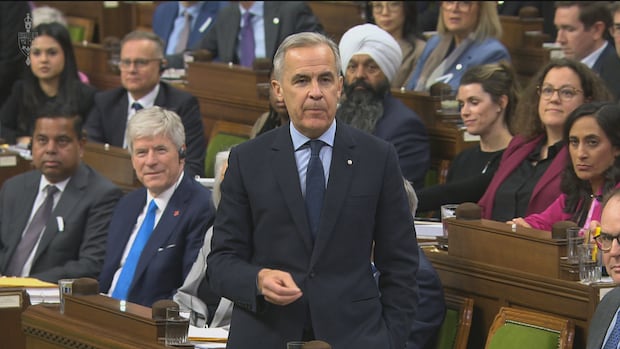
In response to a question from Conservative Leader Pierre Poilievre on Tuesday, Prime Minister Mark Carney informed the House of Commons that ‘when I make a mistake, I’ll admit it.’ Carney was referencing his earlier comment of ‘who cares’ regarding his halted discussions with U.S. President Donald Trump.
Carney expressed regret after receiving significant criticism from the Opposition Conservatives.
“When I had the great honour of being elected as a deputy in this House by my constituents, I made a promise to Canadians that when I make a mistake, I’ll acknowledge it,” Carney remarked, taking a jab at Conservative Leader Pierre Poilievre, who lost his seat in the Ottawa area during the election.
“That was an unfortunate choice of words concerning a critical matter. And the crucial issue is what advancements we are making structurally,” Carney explained, before highlighting the relatively low tariff burden on most Canadian products in the U.S.
Trade discussions between Canada and the U.S. collapsed abruptly last month after Trump criticized Canada for Ontario Premier Doug Ford’s anti-tariff advertisement campaign that referenced Ronald Reagan.
A representative for Carney informed CBC News on Monday that he is contemplating a visit to Washington next week for the FIFA World Cup draw, which Canada, the U.S., and Mexico will co-host in 2026.
The draw, scheduled to occur at the Kennedy Centre, a performing arts venue that Trump now oversees personally, will establish the group-stage matchups for the prestigious soccer event.
In the meantime, Poilievre claimed that Carney’s dismissive response indicates a lack of seriousness in addressing the tariff issue and that he has abandoned his “elbows up” strategy toward the U.S.
“Workers on the line care, Canadians care. Why doesn’t the prime minister care?” Poilievre questioned during the question period.
Poilievre pointed out that Carney’s international trips have yet to yield significant outcomes — tariff rates with the U.S. have actually increased since his initial election.
Carney countered that Poilievre is mistaken and should “verify his figures,” noting that Indonesia, the fourth-most populous nation globally, has consented to eliminate 95 percent of its tariffs on Canadian products following a free trade agreement.
After a recent trip to the United Arab Emirates to finalize a foreign investment agreement, Carney mentioned that investors from that affluent Gulf nation are ready to invest around $70 billion into the Canadian economy.
-
FRONT BURNER
What did Reagan really believe about tariffs?
-
Analysis
It’s not the tariffs, it’s the chaos
Foreign Affairs Minister Anita Anand referred to that commitment as the “largest foreign investment in Canadian history.”
Additionally, while U.S. tariffs have increased on certain Canadian exports like steel and automobiles, Carney remarked that Canada still benefits from the lowest overall tariff burden globally due to the unique provisions of the Canada-U.S.-Mexico Agreement (CUSMA).
Regarding assistance for workers in sectors impacted by tariffs, Natural Resources Minister Tim Hodgson mentioned that more support will be announced later this week for industries that have been disrupted by Trump’s protectionist measures.
The forestry industry, in particular, has suffered significantly from a harmful mix of American tariffs and countervailing duties, which collectively exceed 40 percent, a burden that has already led to the closure of some mills.
