

To reduce the approval timeline for Canada’s upcoming high-speed rail system by 50%, the Liberal government is revising its land expropriation processes, a move that some critics argue may undermine property rights and lead to expensive errors.
The Budget 2025 Implementation Act (BIA), which includes various provisions from the budget, also brings modifications to the Expropriation Act and other legislation, facilitating a swifter acquisition of land by the federal government for the railway project.
“They’ve removed protections for the sake of expediency, but I wouldn’t say these were solely safeguards for homeowners,” commented Shane Rayman, a lawyer in Toronto who focuses on expropriation law, in an interview with CBC News. “These protections serve to shield both parties from errors that can occur in a highly intricate process.”
Transport Canada informed CBC News that alterations to the expropriation process were necessary due to the “geometric requirements of high-speed rail,” which impose tight constraints on track curvature, thus limiting the range of suitable land for the development.
The envisioned route connecting Quebec City and Toronto — which Prime Minister Mark Carney aims to commence construction on within four years — will include stops in Trois-Rivières, Laval, Montreal, Ottawa, and Peterborough.
-
High-speed rail line with 300 km/h trains will run between Toronto and Quebec City, Trudeau announces
-
How high-speed rail would change Ontario and Quebec — if it actually happens
The department asserts that, despite the modifications, landowners will still receive fair treatment.
“Individuals and entities affected by expropriation will continue to receive just compensation based on established norms, including market value and other relevant expenses,” a representative from Transport Canada stated via email.
However, the Montreal Economic Institute (MEI), a think tank based in Quebec, disputes this perspective, arguing in a commentary on its website that essential safeguards are being “discarded,” jeopardizing the livelihoods of farmers and other landowners.
“Ignoring property owners is not an appropriate way to treat Canadians, and trying to conceal such a diminishment of property rights in an omnibus bill only exacerbates the issue,” the commentary added.
Abolishing hearings
According to Section 10 (1) of the Expropriation Act, the minister must call for a hearing when an objection is presented. The modifications in the BIA, which is currently undergoing second reading in the House, remove this obligation.
Rayman believes hearings are valuable as they provide both the federal government and the landowner an opportunity to reassess the rationale behind the acquisition — a process that can frequently lead to adjustments in planning.
“I’ve previously witnessed instances where the government realizes they aren’t adhering to regulations, they haven’t substantiated their needs, or they’ve taken land that is inaccessible or for which there’s no valid reason for acquisition,” he remarked.
Rayman contends that identifying these mistakes and proposing solutions often benefits the government by allowing them to avoid unnecessary land purchases.
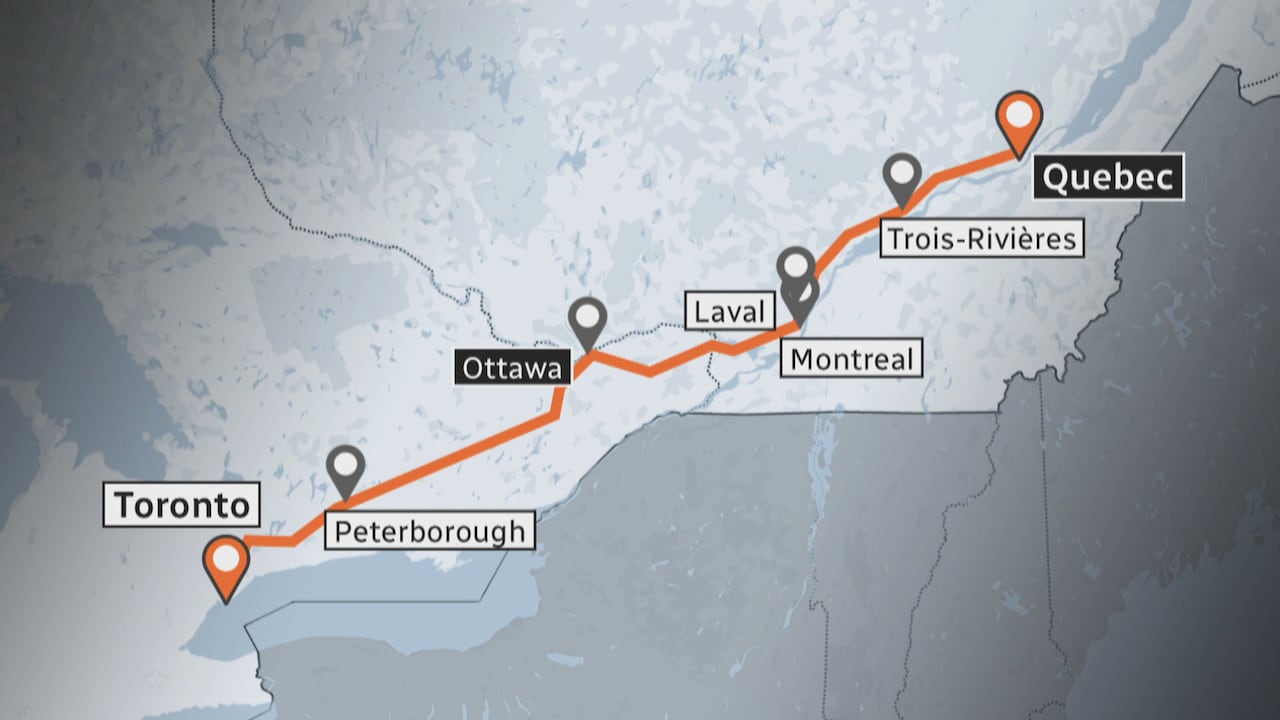
The proposed rail project is designed to connect Quebec City and Toronto, with multiple stops in between. (CBC)
If the Expropriation Act is revised, landowners can still object, but the minister will make a decision without holding a hearing. If the government seeks to finalize its expropriation, the minister need only provide a written reply.
Transport Canada assured CBC News that “all objections will be evaluated prior to reaching a conclusion,” and landowners are permitted to contest compensation amounts in Federal Court. Nonetheless, critics argue that this could lead to mistakes.
Renaud Brossard from the MEI stated that during land expropriations, the balance of power favors the government, making due process crucial for protecting homeowners.
“There are valid concerns that landowners might raise during that process which the government might overlook,” he explained.
Brossard noted that through consultation, alternative routes and right-of-ways can be identified that would allow landowners to retain their properties while still permitting the construction of the project.
Rayman mentioned that landowners have, on occasion, employed the hearing process as a means to delay, and this modification likely aims to prevent that scenario.
Restrictions and the right of first refusal
The legislative amendments also empower the federal government to impose a “prohibition on work” on a property that is not yet expropriated but may be needed for the railway.
Once such a prohibition is enacted, the landowner is barred from undertaking any improvements on their land or buildings for a duration of four years or until the prohibition is rescinded.
“That’s a considerable length of time for someone wishing to renovate their home, and it’s also lengthy for anyone with a development property acquired as an investment,” Rayman stated.
Any ongoing work at the time the government declares an interest may proceed, but anyone initiating work after a prohibition has been issued could face prosecution.
Transport Canada indicated that the prohibition aims to “curb land speculation” and other efforts to inflate the value of properties that may be necessary for the high-speed rail line.
“It does not prevent landowners from conducting essential repairs and maintenance,” the spokesperson clarified.

The journey time between cities could be significantly reduced, potentially influencing travel patterns and residential choices. However, some critics argue that the costs associated with the federal government’s initiative may render high-speed rail in Canada unattainable.
The federal government is also allowed to issue a “right of first refusal” notice concerning land sales where work is restricted.
As per the BIA, when a landowner receives an offer from a third party, they must present this offer to the federal government, which then has the right to “purchase the land at the price specified in the agreement.”
Rayman notes that, in many instances, potential buyers may refrain from making offers on land encumbered by a right of first refusal.
“I would consider it a significant drawback for the title because it affects the owner’s ability to sell the property,” he remarked.
-
Could new rail line be ‘costly boondoggle’ or economic boon for Toronto?
-
Federal government going ahead with high-speed rail between Quebec City and Toronto
-
What will the federal government’s Major Projects Office do — and will it succeed?
Rayman argues that both provincial and federal expropriation laws, alongside how these laws have been interpreted in courts, reflect an intention to ensure that landowners are compensated for any losses incurred due to expropriation.
He emphasizes that this compensation should encompass not only the land’s value but also the economic impact on surrounding properties and the repercussions of having a high-speed train traverse part of their land.
“It seems that these adjustments do not alter an owner’s rights to compensation and to being made whole under the Expropriation Act, but rather aim to expedite the process,” he stated.
Alto, the Via Rail subsidiary responsible for developing the project, plans to conduct its initial round of public consultations regarding the proposed route this winter, focusing on a broader corridor for the tracks. Two additional rounds of consultations will follow over the next 18 months, concentrating on a more defined route and considering results from studies on wildlife, environmental impacts, as well as noise, water, and air quality assessments.
Alto informed CBC News that it would refrain from commenting publicly on the changes to the Expropriation Act outlined in the BIA at this moment.
