

As Ontario faces its most severe fire season on record, new findings from McGill University confirm that aspen trees can serve as a barrier against fires.
Flavie Pelletier, a doctoral graduate and the principal author of the study, noted that aspen trees have long been considered, based on anecdotal evidence, to be particularly resistant to fire.
“However, the irony is that aspen can ignite rapidly on its own due to its thin bark,” she explained.
Through the examination of satellite images of Canada’s boreal forest taken before and after wildfires, Pelletier and her research team discovered that extensive aspen patches can help decelerate wildfires.
The comparative images indicated that larger areas of aspen were more commonly found along the edges of the burned regions.
Pelletier proposed several theories regarding the role of aspen patches as fire barriers.
“Aspen trees possess significantly higher moisture content in both their wood and leaves compared to coniferous species,” she stated.
Additionally, aspen leaves typically begin at a higher point on the trunk than the needles of coniferous trees such as spruce and pine. This positioning increases the likelihood that a ground fire will reach other tree types first.
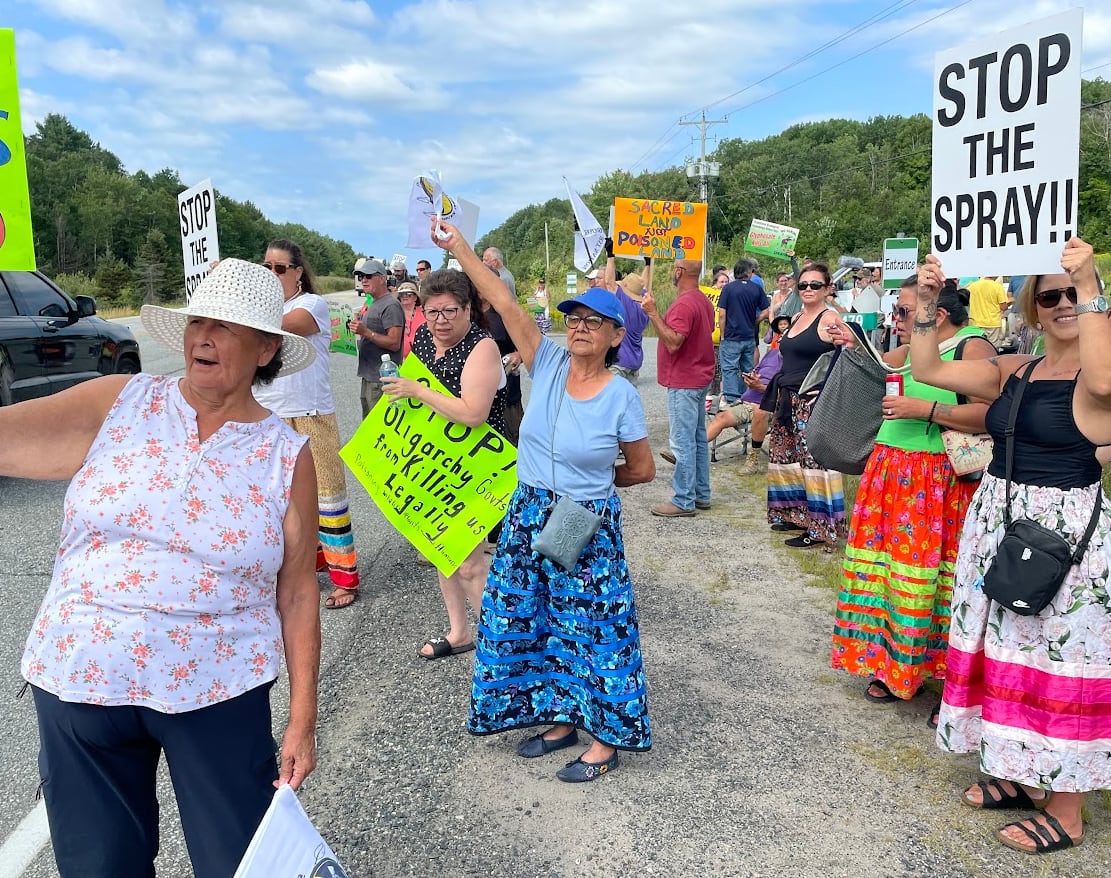
Last summer, members of the Serpent River First Nation protested against glyphosate use by forestry companies in Ontario. (Jonathan Migneault/CBC)
‘Conflict with aspen’
While aspen can mitigate wildfire spread, Pelletier remarked, “there seems to be an ongoing conflict against aspen in commercial forestry.”
Each summer, forestry companies in Ontario apply herbicides across thousands of hectares of Crown land to eliminate broadleaf plants that compete with coniferous trees, which are harvested for timber.
Glyphosate is the most frequently utilized herbicide for this purpose.
“If you significantly diminish aspen in commercial forests, whether through herbicide application or brushing, I genuinely believe that you are elevating fire risk in the long run,” Pelletier asserted.
Fred Pinto, an adjunct professor of forestry at the University of Toronto and former executive director of the Ontario Professional Foresters Association, mentioned that some research indicates broadleaf species like aspen can reappear in landscapes after glyphosate treatment.
He noted that the resurgence of these broadleaf species may take between five to ten years.
Pinto stated that only a small fraction of Ontario’s boreal forest is logged annually and he was unaware of any studies that demonstrate whether forests treated with glyphosate are more susceptible to wildfires.
He added that many of the ongoing fires in northern Ontario are taking place in remote areas of northwestern Ontario that have neither been logged nor treated with glyphosate.
Regarding the potential toxicity of wildfire smoke from glyphosate-treated forests, Pinto expressed that the impact would be minimal.
He explained that the concentration of glyphosate in the forest would be so minor in comparison to the overall biomass that detecting any airborne chemicals would be nearly impossible.
Furthermore, he noted that wildfires burn at such high temperatures that they would effectively vaporize any glyphosate residues in the atmosphere.
