

On Monday, U.S. President Donald Trump enacted an executive order that designates fentanyl as a weapon of mass destruction. This significant decision greatly enhances the federal government’s powers to combat the synthetic opioid that causes tens of thousands of overdose fatalities in the U.S. annually.
This unprecedented classification for a drug indicates Trump’s commitment to addressing fentanyl as a national security issue rather than just a public health emergency, equating it to the threat of chemical warfare.
This new classification intensifies efforts against what Trump describes as drug gangs determined to inundate the U.S. with narcotics. It permits the Pentagon to collaborate with law enforcement and enables intelligence agencies to utilize counter-proliferation resources against drug traffickers.
“We are officially categorizing fentanyl as a weapon of mass destruction, which is precisely what it is,” Trump stated during a White House event honoring service members responsible for border security at the southern frontier with Mexico. “They are attempting to drug out our country.”
“Illicit fentanyl is more akin to a chemical weapon than a narcotic,” the order from Trump read.
Democratic Representative Jim McGovern from Massachusetts criticized this action, recalling Trump’s recent pardon of Ross Ulbricht, the Silk Road marketplace founder, which prosecutors claimed facilitated over $200 million in drug sales over a two-year trial period.
“Just a reminder: Trump pardoned the creator of a black market that brought fentanyl from China into the U.S.,” McGovern remarked on social media.
-
Analysis
The U.S. has put military pressure on Venezuela for months. What’s the endgame?
-
As U.S. escalates threats on Maduro, some Venezuelans welcome regime change
Justin Amash, a former Republican Congressman, expressed on X that this is “just another instance of the state manipulating the literal meaning of terms to extend its authority.”
“Similar to ’emergency,’ ‘terrorist,’ and ‘defensive’ — all stretched to an almost boundless extent to rationalize nearly any executive overreach,” Amash added.
Campaign against alleged drug vessels
By designating drug cartels as foreign terrorist organizations earlier this year, Trump has paved the way for potential military action against them. Since early September, the Trump administration has conducted 25 known attacks on suspected drug smuggling vessels in the Caribbean and Pacific, resulting in 95 fatalities.
The U.S. military reported on Monday that it targeted three boats suspected of drug trafficking in the eastern Pacific, with casualties of three in the first boat, two in the second, and three in the third. They did not present any evidence of the vessels’ alleged drug activities but released a video showing one boat moving through the water before it exploded.
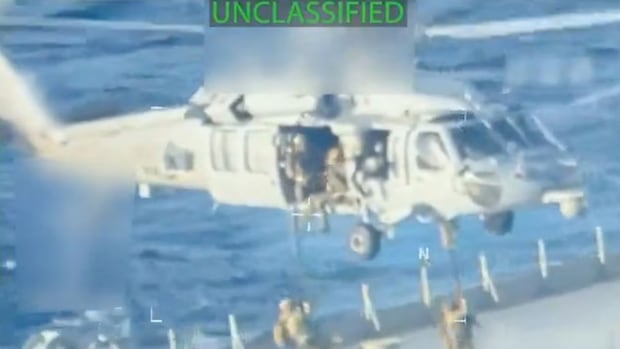
Venezuela’s government says the U.S. seizure of an oil tanker off the coast of Venezuela ‘constitutes a blatant theft and an act of international piracy.’ U.S. Attorney General Pam Bondi says the FBI, the Department of Homeland Security and the U.S. Coast Guard carried out a seizure warrant for the tanker, alleging it was transporting sanctioned oil from Venezuela and Iran.
Legal analysts suggest that these strikes may be unlawful. There has been little to no public evidence that the boats were indeed transporting drugs or that it was necessary to destroy them rather than intercept, seize their cargo, and interrogate the crew.
Trump has consistently threatened to conduct strikes on land within Venezuela, Colombia, and Mexico to combat drug trafficking. In a comprehensive strategy document released last week, Trump asserted that his administration’s foreign policy would concentrate on re-establishing U.S. dominance in the Western Hemisphere.
Some Democrats and Republicans have voiced their opposition, stating that the White House requires congressional approval for the boat strikes.
Opioid overdoses have claimed the lives of at least 68,000 Americans every year since 2020.
Mexico is the primary source of illicit fentanyl entering the U.S., while many of the chemicals used in its production are sourced from China.
Venezuela, as per insights from policy experts at Insight Crime and the United Nations Office on Drugs and Crime, does produce some cocaine but is primarily recognized as a transit hub for cocaine sourced from Colombia, Peru, and Bolivia.
“During my time on the select committee on China in the last Congress, I co-led the fentanyl working group, and I can assure you that 99 percent of fentanyl precursors originate from China, not from Venezuela,” Democratic Congressman Jake Auchincloss, who participated in drug interdiction operations in Central America while serving in the U.S. military, stated in an interview with broadcaster MS Now last month.

Every U.S. president releases a national security strategy document about a year into their term, but few have made as big a splash as Donald Trump’s, earlier this month.
The document formally spells out much of what we’ve come to expect from Trump’s approach to foreign policy in his second term: political relationships are transactional, and American interests take priority above all else. The document also takes particular aim at Europe, and pledges explicit support for right-wing movements abroad.
Bob Rae was, until recently, Canada’s ambassador to the UN, following decades of political office including premier of Ontario. He reads between the document’s lines and explains what it means for Canada — and asks how much of it is actually worth taking seriously.
