

Upon relocating from a private shelter to a communal residence in downtown St. John’s, Kyle Harbin anticipated a sense of stability and the beginning of a new, more comfortable chapter in his life.
He entered into a lease agreement for an apartment managed by the same entity that oversees the shelter, namely 3 Birds Housing Solutions. This lease, which Harbin signed in December 2023, is part of a supported living initiative funded by the Newfoundland and Labrador Housing Corporation (NLHC) designed to assist individuals with complex needs.
Harbin’s monthly rent of $700 is deducted directly from his income support payments. He mentioned that this amount constitutes the bulk of his income, but he manages to cope with the aid of food banks and other support services.
However, this arrangement is set to change at the start of the new year.
The 40-year-old revealed that he received a no-fault eviction notice from the management company in October, requiring him to vacate the premises by the end of February.
“This is a no-fault termination, which means it is not connected to any violation of the lease or tenant behavior,” states the eviction notice provided by 3 Birds Housing Solutions.
The eviction letter, which was shared with CBC News, further indicated that the landlord had given more than the mandatory 90 days written notice.
Program at capacity
3 Birds Housing Solutions declined to participate in an interview and opted not to comment due to privacy concerns.
In a statement sent via email, Housing Minister Joedy Wall mentioned that 3 Birds’ transitional living program necessitates tenant participation in accordance with specific rules and standards. The NLHC provides the property for the program free of charge and supplies a support grant of $71,000.
“Non-profit operators collaborate closely with residents to facilitate program participation, but there are instances when an operator must request that someone leave the program to allow another individual to join and benefit,” Wall stated. “Transitional housing does not fall under the Residential Tenancies Act.”
Wall noted that the 3 Birds program is currently at its maximum capacity with 12 residents, although the NLHC has similar setups available across the province.
“If someone is unable to succeed in a transitional housing program, we encourage them to reach out to well-established community organizations such as Choices for Youth, Stella’s Circle, and End Homelessness St. John’s for assistance in planning their next steps,” he added.
The Progressive Conservatives have set a target of constructing 10,000 new homes within the next five years.
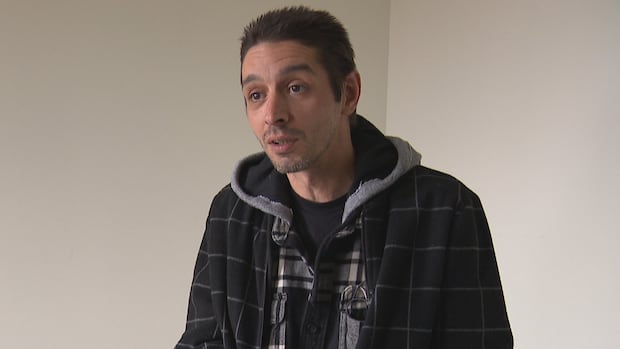
Harbin expressed his aspirations to eventually leave the public housing system for a one-bedroom apartment of his own, a goal that now feels increasingly unattainable.
“I’m unsure about what happens next,” he said, seated in his minimally furnished living space.
He mentioned that searching for a new home is particularly challenging, especially with a pet dog and without steady employment.
“It becomes even more complicated when the system isn’t assisting you in moving forward,” he noted. “I should be employed, but that’s also a significant challenge.”
The institutional circuit
Daniel Kudla, an associate professor of sociology at Memorial University, concurs with numerous experts who assert that the province and the nation are facing a housing crisis.
He pointed out the increasing rates of homelessness, rising rental costs, and the lengthening waitlists for social housing as indicators of a crisis that needs addressing.
Data from End Homelessness St. John’s indicates that as of late September, at least 475 individuals were identified as experiencing homelessness in the city, an increase from 370 individuals reported during the same period last year.

MUN sociology associate professor Daniel Kudla states that it’s ‘inhumane’ to evict someone from stable social housing. (Keira Mahoney/CBC)
Of the homeless population reported in September, 67% were classified as experiencing “chronic homelessness,” meaning they had been homeless for at least six months in the past year.
End Homelessness St. John’s has mentioned that its figures are “always an underestimate” since the non-profit can only account for those individuals it is aware of.
-
One year after Tent City was taken down, issues persist for unhoused in St. John’s
-
St. John’s woman facing eviction hopes the city ‘learns’ from complicated process
Kudla posits that when individuals are evicted from public housing for any reason, they become trapped in what he terms an “institutional circuit.”
“They tend to move back and forth between various public systems such as jails, hospitals, mental health facilities, and emergency shelters,” Kudla explained to CBC News. “None of these solutions address their long-term challenges.”
Uncertain future
Social housing is often viewed as a temporary solution or a last resort. Once that final option disappears, Kudla argues, it leads to a fragmented and chaotic response to emergencies.
“In my opinion, it’s inhumane,” he stated.
In the meantime, Harbin is uncertain about his future. He doubts that four months will suffice to secure affordable housing, but he remains determined to try.
“It’s somewhat ironic that the organization meant to help people off the streets is now forcing me back onto the streets,” he remarked, gazing out the front window of the home he has occupied for the past two years.
Download our free CBC News app to sign up for push alerts for CBC Newfoundland and Labrador. Sign up for our daily headlines newsletter here. Click here to visit our landing page.
