

On Wednesday, the leaders of the two most populous nations in Latin America called for calm as tensions increased due to the United States’ actions concerning neighboring Venezuela.
U.S. President Donald Trump issued an order for a blockade on all oil tankers subject to sanctions that either enter or exit Venezuela, a step labeled a “grotesque threat” by President Nicolás Maduro’s administration.
The Trump administration has deployed thousands of troops and numerous warships, including an aircraft carrier, to the area, escalating the already high tensions. Maduro’s government has denounced these actions, suggesting that the U.S. military seeks to exploit Venezuela’s extensive oil reserves.
During a morning press briefing, President Claudia Sheinbaum stated Mexico opposes any form of intervention or foreign meddling in Venezuela.
“I urge the United Nations to play its role. It has been absent. It needs to step up to prevent any bloodshed,” she stated.
Sheinbaum further emphasized the importance of dialogue and reducing tensions between Venezuela and the United States, offering Mexico as a potential venue for negotiations or discussions between the two nations.
“The entire world must work together to ensure no intervention occurs and that a peaceful resolution is achieved,” she added.
-
Analysis
The U.S. has put military pressure on Venezuela for months. What’s the endgame?
-
Analysis
Maduro’s carefree brush-off of U.S. threats could be his biggest gamble yet
Brazil joins the call for peace
Brazil’s President Luiz Inacio Lula da Silva also advocated for peace in the region.
“I have concerns regarding President Trump’s behavior towards Latin America and the threats,” Lula expressed during a ministerial gathering, noting that he had urged dialogue between Caracas and Washington in a recent conversation with Trump.
“The power of dialogue can surpass the power of weapons… I told Trump: ‘If you genuinely wish to engage with Venezuela, we can assist. However, you must be ready to converse and exercise patience,'” Lula stated.
Lula and Sheinbaum made these remarks shortly before Trump was scheduled to speak to the nation from the White House on Wednesday evening.
Both leftist leaders have been actively involved in trade discussions with the Trump administration and have developed a relatively amicable relationship with the U.S. president.
Tensions between the U.S. and Venezuela have intensified as Trump has positioned thousands of troops and several warships, including an aircraft carrier, in the waters surrounding Venezuela.
In a statement released by his spokesperson on Wednesday, UN Secretary-General Antonio Guterres called for the immediate de-escalation of tensions between the U.S. and Venezuela, urging both nations to “fulfill their obligations under international law, including the UN Charter and any other relevant legal frameworks to uphold peace in the region.”
Guterres reiterated his calls for de-escalation during a phone conversation with Maduro on Wednesday, as stated by the Venezuelan government.
Maduro’s administration has claimed that the U.S. military is intent on seizing control of Venezuela’s extensive oil reserves.
It remains uncertain how Trump plans to enforce the blockade against sanctioned vessels, and whether he will enlist the U.S. Coast Guard to intercept such ships. Last week, the U.S. seized a supertanker near Venezuela.
China backs Venezuela
During a conversation with his Venezuelan counterpart on Wednesday, China’s foreign minister, Wang Yi, expressed opposition to “unilateral bullying” and affirmed support for nations defending their sovereignty.
Wang communicated in a phone call with Venezuelan Foreign Minister Yvan Gil that China and Venezuela are strategic partners, emphasizing that mutual trust and support characterize their bilateral relationship, according to a statement from the Chinese Foreign Ministry.
“China believes the international community recognizes and backs Venezuela’s stance in safeguarding its legitimate rights and interests,” he remarked.
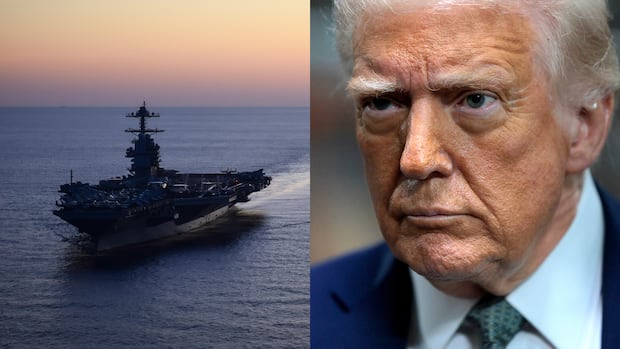
After a series of attacks on alleged ‘narco traffickers’ off Venezuela, the U.S. has deployed its largest aircraft carrier to the region. For The National, CBC’s Eli Glasner explains why President Trump’s show of force may go far beyond fighting drugs.
China was among the few nations to respond critically to the blockade announcement on Wednesday.
China’s interests in this matter are significant. It has been a key destination for between 55 percent and 90 percent of Venezuela’s monthly oil exports, compared to 40 percent to 60 percent last year.
Analysts have cautioned that Venezuelan oil supplies to China could diminish in February if tankers currently loaded and anchored in Venezuelan waters are unable to depart.
Since the U.S. seized the large crude carrier Skipper last week, only Chevron-chartered vessels, which operate under U.S. authorization, have been able to set sail without delays.
At least six tankers have turned back since last week to avoid entering the heavily patrolled Caribbean Sea, according to data from TankerTrackers.com.
By the time the U.S. initiated the seizure of the Skipper, which had transported oil under sanctions from both Venezuela and Iran, the state-run company PDVSA was already struggling to sell its crude at close to contract prices due to an oversupply of sanctioned oil targeting its primary market, China.
More than nine million barrels of Venezuelan oil are currently stranded on ships in Venezuelan waters, according to traders and a company source this week.
Close to 100 fatalities in strikes on boats
Since the summer, the Trump administration has increased the reward for information leading to the capture of the authoritarian leader Maduro, who continues to hold power after a 2024 election deemed neither free nor fair by the U.S. and most Western nations. Additionally, it has conducted a series of controversial and lethal attacks on boats suspected of transporting drugs linked to Maduro’s regime.
In a notification to Congress under the War Powers Act, the Trump administration has stated that the U.S. military is involved in “a non-international armed conflict,” categorizing individuals on the drug-laden vessels as enemy combatants.
Estimates suggest that around 95 individuals have lost their lives in these strikes, and the revelation that two survivors from an initial attack on September 2 were subsequently killed in a follow-up strike has sparked outrage among lawmakers.
-
U.S. defence secretary says Pentagon will not publicly release Sept. 2 boat strike video
-
U.S. admiral’s abrupt retirement spurs command leadership change in Latin America operations
The legality of the entire military campaign has been challenged by nearly all Democrats and a small faction of Republicans, with U.S. lawmakers expressing concerns that it has proceeded without Congressional authorization. Defence Secretary Pete Hegseth and other high-ranking military officials have provided scant details regarding the occupants or cargo aboard the boats, leading to further frustration among legislators.
Moreover, several strikes have occurred far from Venezuela’s coast, in Pacific waters.
Hegseth and the administration have criticized a few Democratic legislators who last month released a video advising service members to refuse unlawful orders, without specifically mentioning the campaign in Venezuela.
The rationale behind the Trump administration’s actions has also faced scrutiny from experts in drug policy, especially since fentanyl has been linked to a significant rise in drug toxicity deaths in the U.S. over the last decade.
“It must be clearly stated — 0.00 percent of fentanyl that arrives in the U.S. comes from Venezuela, the Caribbean, or South America in general,” remarked John Walsh, a drug policy expert at the Washington Office of Latin America, during a recent interview with CBC News.
Mexico is considered the primary source of fentanyl entering the U.S., frequently smuggled through border crossings, with the majority of fentanyl precursors originating in China.
Venezuela is largely perceived as a transit hub for the larger cocaine producers in South America.
