

On Monday, advocacy organizations expressed their concerns on Parliament Hill, claiming that the federal government’s border security legislation opens the door to infringe upon the rights of migrants and should be abandoned.
Members of the Migrant Rights Network, the Canadian Council for Refugees, and other advocacy groups held a press conference after they were unable to secure spots on the witness lists for Commons committees examining Bill C-12.
“Bill C-12, which spans 70 pages and proposes modifications to nine existing laws, has only been allocated three weeks for examination,” stated Karen Cocq, a spokesperson for the Migrant Rights Network.
“Throughout this period, no migrants affected by C-12—those who might face permit cancellations or denial of refugee protection—have had the opportunity to address the committee.”
The initiatives included in Bill C-12 originated from the government’s earlier border security proposal, Bill C-2, which was launched in June.

The proposed border security legislation Bill C-2 was introduced by Prime Minister Mark Carney’s government in June, while some immigration-related provisions were later included in Bill C-12. (Nathan Denette/The Canadian Press)
In October, the government reintroduced certain elements of the original legislation in a separate bill, aiming for a quicker passage compared to C-2, which contains contentious measures granting new powers to security and intelligence agencies, as well as allowing Canada Post to open mail.
Bill C-12 encompasses various immigration and asylum provisions, including a stipulation that prevents individuals from submitting refugee applications to the Immigration and Refugee Board of Canada if they have resided in Canada for over a year.
Gauri Sreenivasan, co-executive director at the Canadian Council for Refugees, remarked that this limitation could hinder individuals’ ability to seek asylum in response to evolving conditions in their home countries.
“In the U.S., we’ve recently observed how overnight, someone who is transgender can be rendered nonexistent,” she noted.
According to Sreenivasan, individuals escaping domestic violence might also find the proposed one-year stipulation challenging, as gathering evidence, securing legal representation, and filing a claim within that timeframe can be difficult.
Ottawa defends legislation
The government has stood by this provision, asserting that those not eligible for standard refugee hearings can still undergo pre-removal risk assessments. Officials from the Immigration Department have informed the House of Commons immigration committee that these assessments pose similar questions and review the same evidence as those presented in hearings before the Immigration and Refugee Board.
Bill C-12 would also empower the government to cease accepting new immigration applications or revoke existing ones if deemed necessary for the “public interest.”
Immigration Minister Lena Diab and department representatives have indicated that the term “public interest” is intentionally left ambiguous in the legislation to allow the government flexibility in addressing various future scenarios, such as pandemics or espionage threats.
The bill is currently under review by the House of Commons immigration and national security committees and is set for clause-by-clause examination at the national security committee hearing on Tuesday.
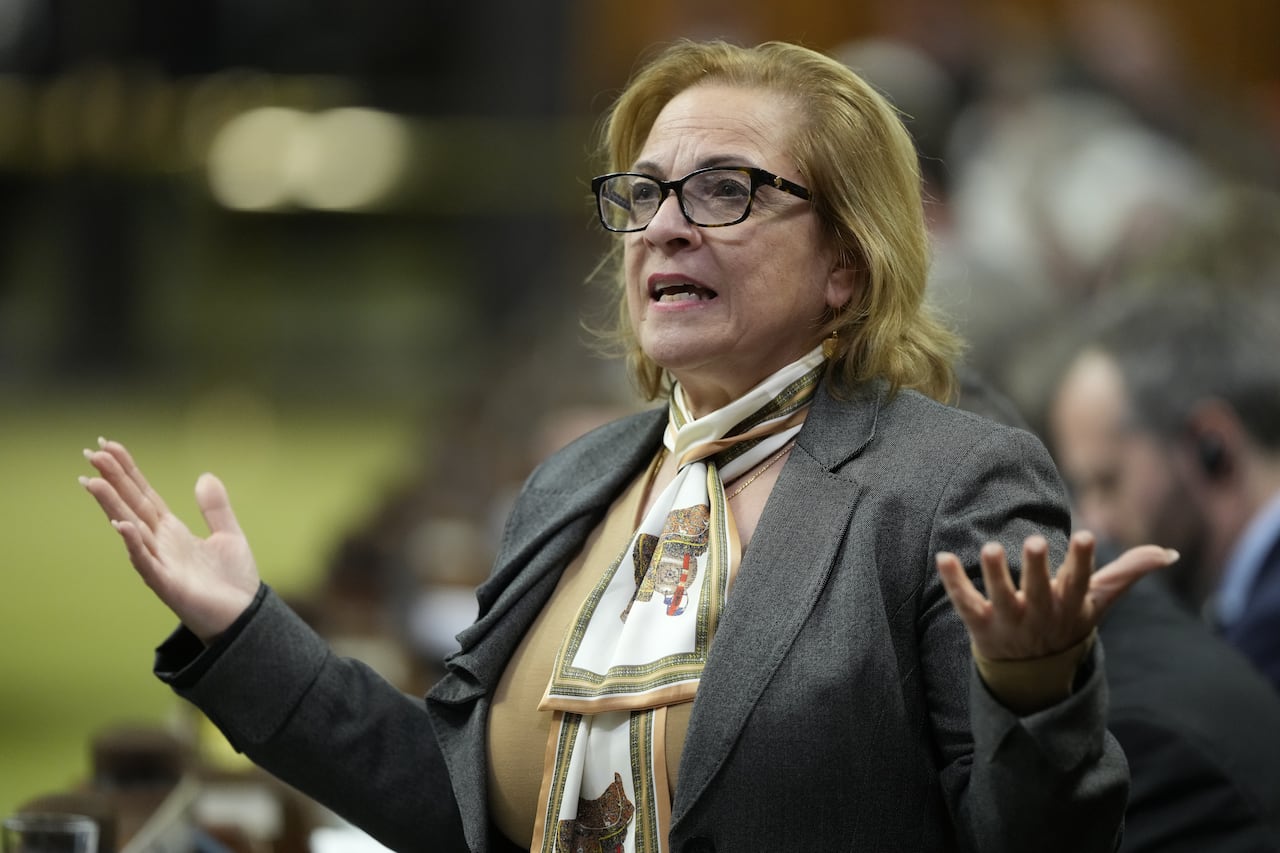
Immigration, Refugees and Citizenship Minister Lena Diab asserts that the bill is structured to empower officials to maintain the security of the immigration system. (Adrian Wyld/The Canadian Press)
Last week, Conservative immigration critic Michelle Rempel Garner announced her intention to propose multiple amendments, including one that would prevent refugee applications from individuals arriving in Canada from a European or G7 country.
Cocq argued that Rempel Garner’s proposed amendments resemble a law established during the Stephen Harper administration in 2012, which denied refugees from “safe countries” the right to appeal. This law was ruled unconstitutional by the Federal Court in 2015.
“The idea that entire groups can be excluded from the system entirely challenges fundamental principles of fairness,” Cocq remarked.
